Roto
MY ROLECAD, programming & testing
A robot that uses two stepper motors to follow a programmed route through a maze, pass through gates, and push water bottles into bonus areas. I handled all CAD design, programming, and testing.
Engineering process
Taking on the event
I took on Robot Tour in December because my team needed help. My starting point was to adapt the stepper-control approach from the EV into a robot that could execute a programmed route.
My role
I completed all CAD design, wrote all the code, and carried out the robot testing.
The course objective
Navigate the maze, pass through its gates, and push water bottles into designated bonus areas. The robot needed to combine accurate positioning with enough speed to complete the route efficiently.
Adapting the EV control approach
I adapted the EV's stepper-motion logic for two drive motors. The program turns a route script into straight movements and turns, with step counts and motion profiles controlling each segment.
Testing and results
Testing showed fast, accurate movement and successful bottle pushing. Roto placed second at both the regional and state competitions. The gallery includes both competition runs, alongside photographs of the enclosure and internal electronics.
Explore the build
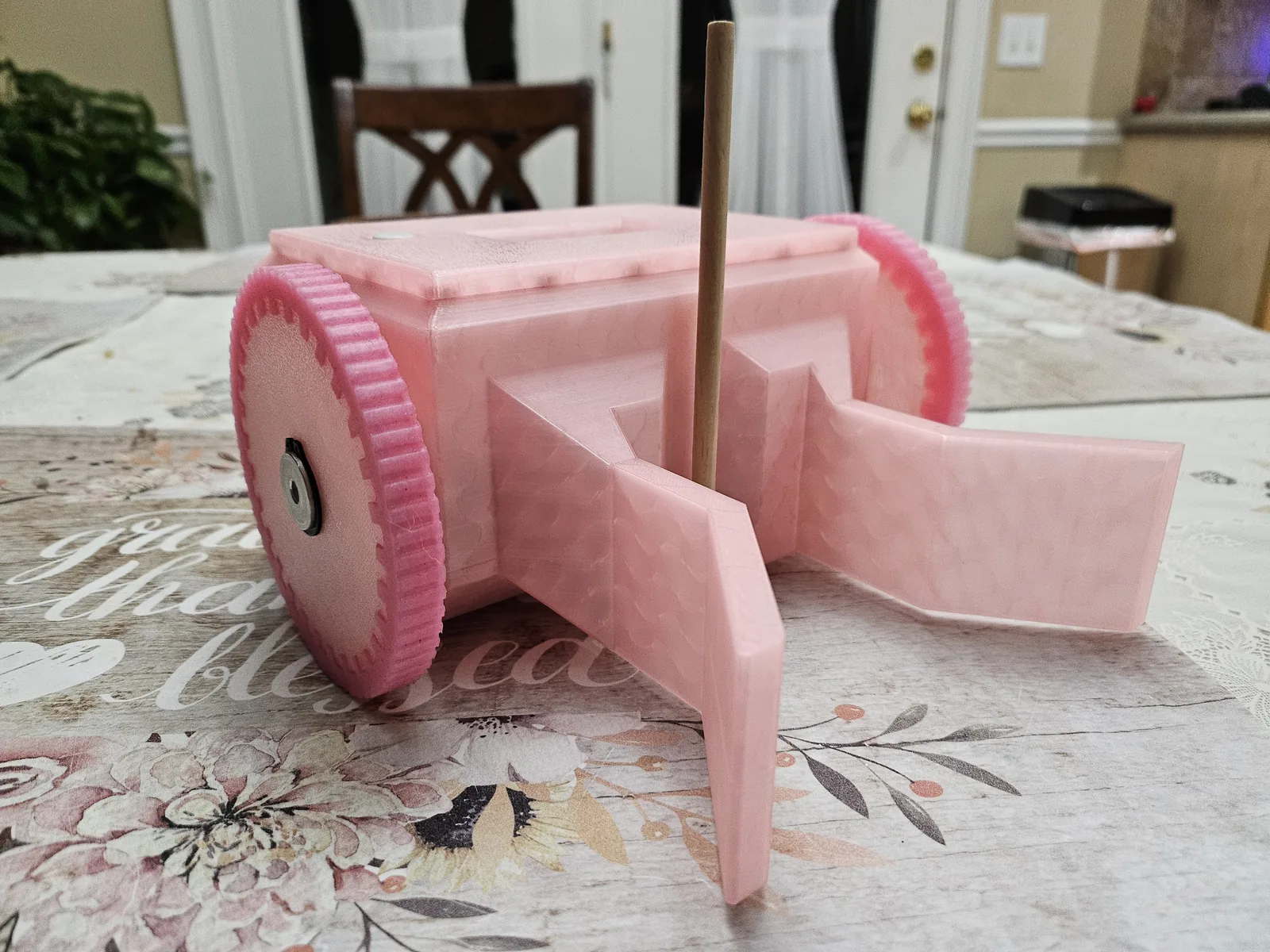
The assembled robot
Roto with its enclosure closed and its front structure in place.
Open photoState competition
2nd placeRoto navigates the marked course between wooden barriers.
Open videoRegional competition
2nd placeRoto makes turns through the regional competition course.
Open video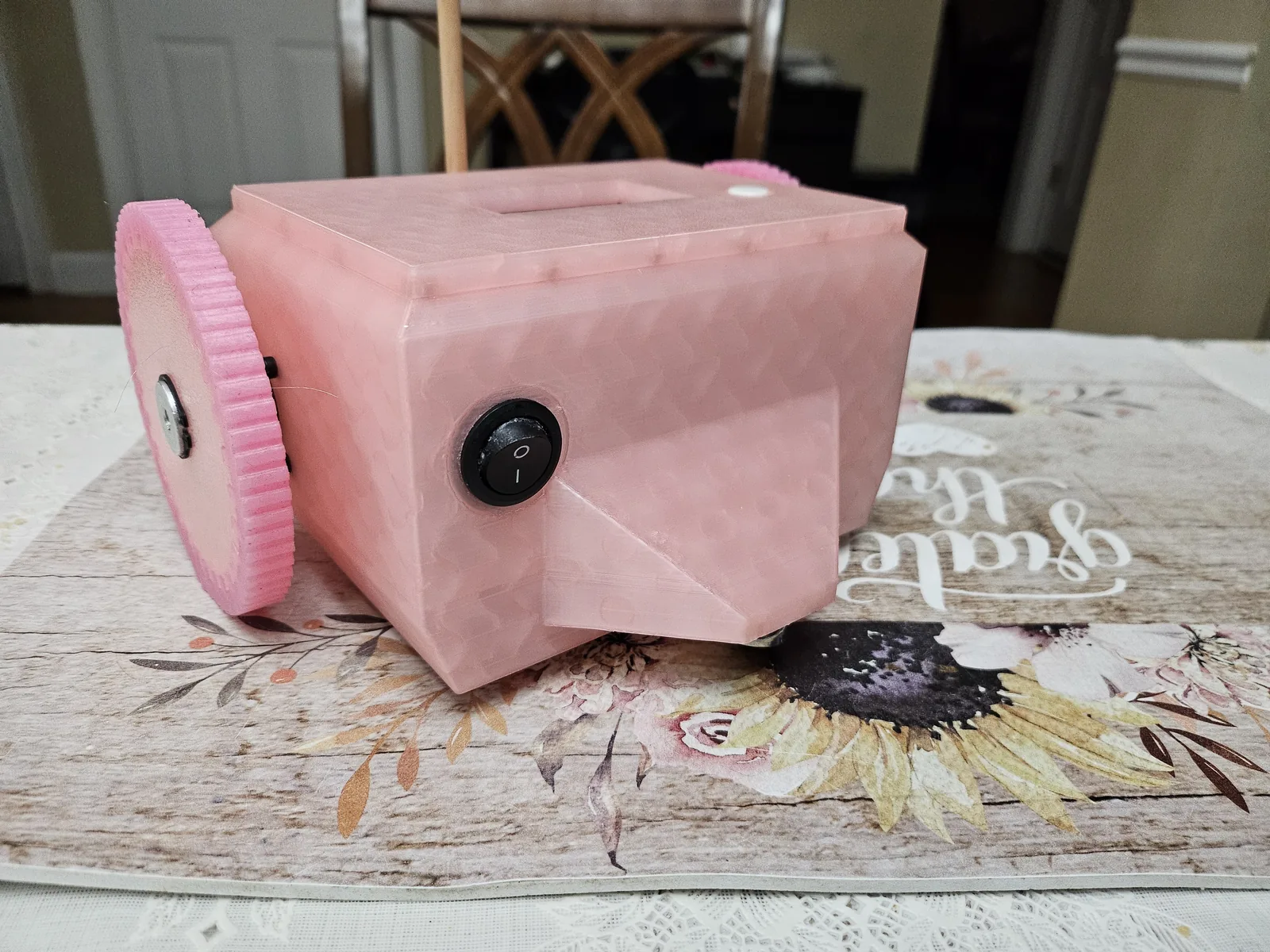
Enclosure detail
The rear of the enclosure, wheels, and power switch.
Open photo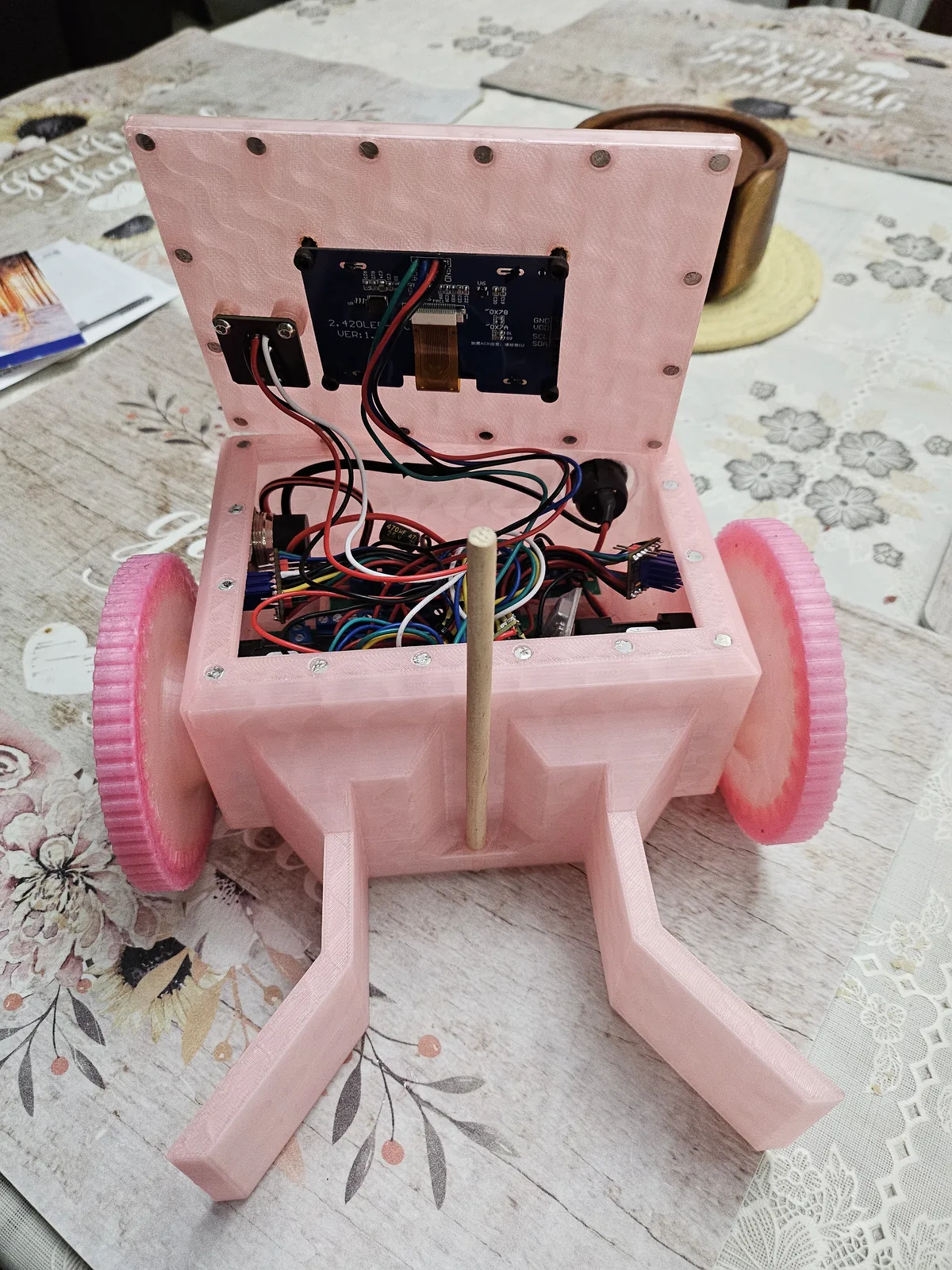
Inside Roto
The open enclosure reveals the wiring and control electronics.
Open photoScripted route control
Parses forward, reverse, and turn commands into wheel movements. Straight-line speeds are recalculated at each segment using the remaining time budget.
- Run-time target
- 62 s
- 90° turn target
- 1.2 s
- Library
- AccelStepper
Timing values are configured targets. The route is planned from commanded wheel steps.
#include <Arduino.h>
#include <AccelStepper.h>
#include <math.h>
#include <ctype.h>
#include <string.h>

#define EN1   4
#define STEP1 5
#define DIR1  6

#define EN2   7
#define STEP2 8
#define DIR2  9

#define BUTTON_PIN 12

AccelStepper m1(AccelStepper::DRIVER, STEP1, DIR1);
AccelStepper m2(AccelStepper::DRIVER, STEP2, DIR2);

// ----------------- USER SETTINGS -----------------
float TOTAL_TIME_S = 62.0f;   // total run time target
float TURN_TIME_S  = 1.2f;   // each 90-deg turn must take this long (seconds)

// new wheels: 3 7/8 inch diameter
const float WHEEL_DIAMETER_CM = 3.875f * 2.54f;

// steps per full wheel revolution (already includes microstepping if you set it that way)
const int   STEPS_PER_REV = 3200;

// wheel path radii from robot turn center (mm)
const float WHEEL_OFFSET_M1_MM = 90.66f;  // left wheel center offset
const float WHEEL_OFFSET_M2_MM = 90.66f;  // right wheel center offset

// 90-degree arc length for each wheel (cm): s = (pi/2)*r
const float TURN_ARC_CM_M1 = (PI * 0.5f) * (WHEEL_OFFSET_M1_MM / 10.0f);
const float TURN_ARC_CM_M2 = (PI * 0.5f) * (WHEEL_OFFSET_M2_MM / 10.0f);

// accelstepper tuning caps
float STRAIGHT_ACCEL_STEPSPS2 = 8000.0f;
float TURN_ACCEL_STEPSPS2     = 5000.0f;

float STRAIGHT_VMAX_MAX = 4500.0f;
float TURN_VMAX_MAX     = 2200.0f;
float VMIN_STEPSPS      = 80.0f;

bool ENABLE_ACTIVE_LOW = true;

// Script syntax:
// s50;  -> forward 50 cm
// b20;  -> backward 20 cm
// l;    -> 90° left
// r;    -> 90° right
// a;    -> 180° turn-around (two rights)
const char SCRIPT[] = R"(
s178.5;
a;
s100;
l;
s50;
r;
s50;
b96.5;
l;
s50;
l;
s50;
l;
s50;
b46.5;
l;
s150;
b50;
r;
s100;
l;
s50;
r;
s50;
r;
s50;
a;
s50;
r;
s50;
b48.5;
r;
s56.7;
)";
// --------------------------------------------------

// segment type MUST be defined before any function uses it
enum SegType : uint8_t { SEG_FWD = 0, SEG_TURN_L = 1, SEG_TURN_R = 2 };

struct Segment {
  SegType type;
  float   cm;   // only meaningful for SEG_FWD
  long    s1;   // steps for motor 1 (signed)
  long    s2;   // steps for motor 2 (signed)
};

const int MAX_SEGS = 150;
Segment segs[MAX_SEGS];
int segCount = 0;
int segIdx   = 0;

bool started = false;
unsigned long runStartMs = 0;

// ----------------- Math helpers -----------------
static inline int cmToSteps(float cm) {
  return (int)lroundf((cm / (PI * WHEEL_DIAMETER_CM)) * (float)STEPS_PER_REV);
}

// solve vmax for trapezoid/triangle time T with accel a and distance d_steps (absolute)
static bool solve_vmax(long d_steps, float T, float a, float &vmax_out) {
  if (T <= 0.0f || a <= 0.0f) return false;

  double d = (double)((d_steps >= 0) ? d_steps : -d_steps);
  double A = 1.0 / (double)a;
  double B = -(double)T;
  double C = d;

  double disc = B*B - 4.0*A*C;
  if (disc < 0.0) return false;

  double sqrt_disc = sqrt(disc);
  double v1 = (-B - sqrt_disc) / (2.0*A);
  double v2 = (-B + sqrt_disc) / (2.0*A);

  double v = v1;
  if (v <= 0.0) v = v2;
  if (v <= 0.0) return false;

  vmax_out = (float)v;
  return true;
}

// ----------------- Parser helpers -----------------
static inline void skipWS(const char* &p) {
  while (*p && (isspace((unsigned char)*p) || *p == '\r' || *p == '\n')) p++;
}

static bool parseFloat(const char* &p, float &out) {
  skipWS(p);
  char* endp = nullptr;
  out = strtof(p, &endp);
  if (endp == p) return false;
  p = endp;
  return true;
}

static bool eatChar(const char* &p, char c) {
  skipWS(p);
  if (*p != c) return false;
  p++;
  return true;
}

static void pushSeg(SegType type, float cm, long s1, long s2) {
  if (segCount >= MAX_SEGS) return;
  segs[segCount].type = type;
  segs[segCount].cm   = cm;
  segs[segCount].s1   = s1;
  segs[segCount].s2   = s2;
  segCount++;
}

static bool parseScript() {
  segCount = 0;
  const char* p = SCRIPT;

  while (1) {
    skipWS(p);
    if (!*p) break;

    char c = (char)tolower((unsigned char)*p);

    if (c == 's') {
      p++;
      float cm = 0.0f;
      if (!parseFloat(p, cm)) return false;
      if (!eatChar(p, ';')) return false;

      long s = (long)cmToSteps(cm);
      if (segCount > 0 && segs[segCount-1].type == SEG_FWD && ((segs[segCount-1].cm > 0) == (cm > 0))) {
        segs[segCount-1].cm += cm;
        segs[segCount-1].s1 += s;
        segs[segCount-1].s2 -= s;
      } else {
        pushSeg(SEG_FWD, cm, s, -s);
      }
      continue;
    }

    if (c == 'b') {
      p++;
      float cm = 0.0f;
      if (!parseFloat(p, cm)) return false;
      if (!eatChar(p, ';')) return false;

      float cmNeg = -cm;
      long s = (long)cmToSteps(cmNeg);
      if (segCount > 0 && segs[segCount-1].type == SEG_FWD && ((segs[segCount-1].cm > 0) == (cmNeg > 0))) {
        segs[segCount-1].cm += cmNeg;
        segs[segCount-1].s1 += s;
        segs[segCount-1].s2 -= s;
      } else {
        pushSeg(SEG_FWD, cmNeg, s, -s);
      }
      continue;
    }

    if (c == 'l') {
      p++;
      if (!eatChar(p, ';')) return false;

      long s1 = (long)cmToSteps(TURN_ARC_CM_M1);
      long s2 = (long)cmToSteps(TURN_ARC_CM_M2);
      pushSeg(SEG_TURN_L, 0.0f, -s1, -s2);
      continue;
    }

    if (c == 'r') {
      p++;
      if (!eatChar(p, ';')) return false;

      long s1 = (long)cmToSteps(TURN_ARC_CM_M1);
      long s2 = (long)cmToSteps(TURN_ARC_CM_M2);
      pushSeg(SEG_TURN_R, 0.0f,  s1,  s2);
      continue;
    }

    if (c == 'a') {
      p++;
      if (!eatChar(p, ';')) return false;

      long s1 = (long)cmToSteps(TURN_ARC_CM_M1);
      long s2 = (long)cmToSteps(TURN_ARC_CM_M2);
      pushSeg(SEG_TURN_R, 0.0f, s1, s2);
      pushSeg(SEG_TURN_R, 0.0f, s1, s2);
      continue;
    }

    return false;
  }

  return segCount > 0;
}

// ----------------- Time-based speed logic -----------------
static int turnsRemainingFrom(int fromIdx) {
  int n = 0;
  for (int i = fromIdx; i < segCount; i++) if (segs[i].type != SEG_FWD) n++;
  return n;
}

static float straightStepsRemainingFrom(int fromIdx) {
  double sum = 0.0;
  for (int i = fromIdx; i < segCount; i++) {
    if (segs[i].type == SEG_FWD) sum += (double)labs(segs[i].s1);
  }
  return (float)sum;
}

// recompute straight vmax so straights finish in remaining straight-time
static float computeStraightVmaxNow(int idx) {
  float elapsed = (millis() - runStartMs) / 1000.0f;
  float targetLeft = TOTAL_TIME_S - elapsed;
  if (targetLeft < 0.05f) targetLeft = 0.05f;

  int tRem = turnsRemainingFrom(idx);
  float timeTurnsLeft = (float)tRem * TURN_TIME_S;
  float timeStraightsLeft = targetLeft - timeTurnsLeft;
  if (timeStraightsLeft < 0.05f) timeStraightsLeft = 0.05f;

  float stepsStraightsLeft = straightStepsRemainingFrom(idx);
  if (stepsStraightsLeft < 1.0f) stepsStraightsLeft = 1.0f;

  float vavg = stepsStraightsLeft / timeStraightsLeft;

  float stepsThis = (float)labs(segs[idx].s1);
  if (stepsThis < 1.0f) stepsThis = 1.0f;

  float Ti = stepsThis / vavg;
  if (Ti < 0.02f) Ti = 0.02f;

  float vmax = 0.0f;
  bool ok = solve_vmax((long)stepsThis, Ti, STRAIGHT_ACCEL_STEPSPS2, vmax);
  if (!ok) vmax = stepsThis / Ti;

  if (vmax < VMIN_STEPSPS) vmax = VMIN_STEPSPS;
  if (vmax > STRAIGHT_VMAX_MAX) vmax = STRAIGHT_VMAX_MAX;
  return vmax;
}

// compute per-wheel vmax for turns so the turn completes in TURN_TIME_S
static void computeTurnVmax(float &v1, float &v2, long steps1, long steps2) {
  long d1 = (long)labs(steps1);
  long d2 = (long)labs(steps2);
  if (d1 < 1) d1 = 1;
  if (d2 < 1) d2 = 1;

  float tv1 = 0.0f, tv2 = 0.0f;
  bool ok1 = solve_vmax(d1, TURN_TIME_S, TURN_ACCEL_STEPSPS2, tv1);
  bool ok2 = solve_vmax(d2, TURN_TIME_S, TURN_ACCEL_STEPSPS2, tv2);

  if (!ok1) tv1 = (float)d1 / TURN_TIME_S;
  if (!ok2) tv2 = (float)d2 / TURN_TIME_S;

  if (tv1 < VMIN_STEPSPS) tv1 = VMIN_STEPSPS;
  if (tv2 < VMIN_STEPSPS) tv2 = VMIN_STEPSPS;
  if (tv1 > TURN_VMAX_MAX) tv1 = TURN_VMAX_MAX;
  if (tv2 > TURN_VMAX_MAX) tv2 = TURN_VMAX_MAX;

  v1 = tv1;
  v2 = tv2;
}

// ----------------- Button + segment start -----------------
static bool debouncePressed() {
  static int lastRead = HIGH;
  static unsigned long t0 = 0;
  static int stable = HIGH;

  int r = digitalRead(BUTTON_PIN);
  if (r != lastRead) { lastRead = r; t0 = millis(); }
  if ((millis() - t0) > 25) stable = r;

  static int lastStable = HIGH;
  bool pressed = (lastStable == HIGH && stable == LOW);
  lastStable = stable;
  return pressed;
}

static void startSegment(int idx) {
  if (segs[idx].type == SEG_FWD) {
    float vmax = computeStraightVmaxNow(idx);
    m1.setMaxSpeed(vmax);
    m2.setMaxSpeed(vmax);
    m1.setAcceleration(STRAIGHT_ACCEL_STEPSPS2);
    m2.setAcceleration(STRAIGHT_ACCEL_STEPSPS2);
  } else {
    float v1 = 0.0f, v2 = 0.0f;
    computeTurnVmax(v1, v2, segs[idx].s1, segs[idx].s2);
    m1.setMaxSpeed(v1);
    m2.setMaxSpeed(v2);
    m1.setAcceleration(TURN_ACCEL_STEPSPS2);
    m2.setAcceleration(TURN_ACCEL_STEPSPS2);
  }

  m1.move(segs[idx].s1);
  m2.move(segs[idx].s2);
}

void setup() {
  pinMode(EN1, OUTPUT);
  pinMode(EN2, OUTPUT);
  digitalWrite(EN1, ENABLE_ACTIVE_LOW ? LOW : HIGH);
  digitalWrite(EN2, ENABLE_ACTIVE_LOW ? LOW : HIGH);

  pinMode(BUTTON_PIN, INPUT_PULLUP);

  m1.setCurrentPosition(0);
  m2.setCurrentPosition(0);
}

void loop() {
  if (!started && debouncePressed()) {
    if (parseScript()) {
      started = true;
      segIdx = 0;
      runStartMs = millis();
      startSegment(segIdx);
    }
  }

  m1.run();
  m2.run();

  if (started && m1.distanceToGo() == 0 && m2.distanceToGo() == 0) {
    segIdx++;
    if (segIdx >= segCount) {
      started = false;
    } else {
      startSegment(segIdx);
    }
  }
}