EV 2026
MY ROLECAD & programming
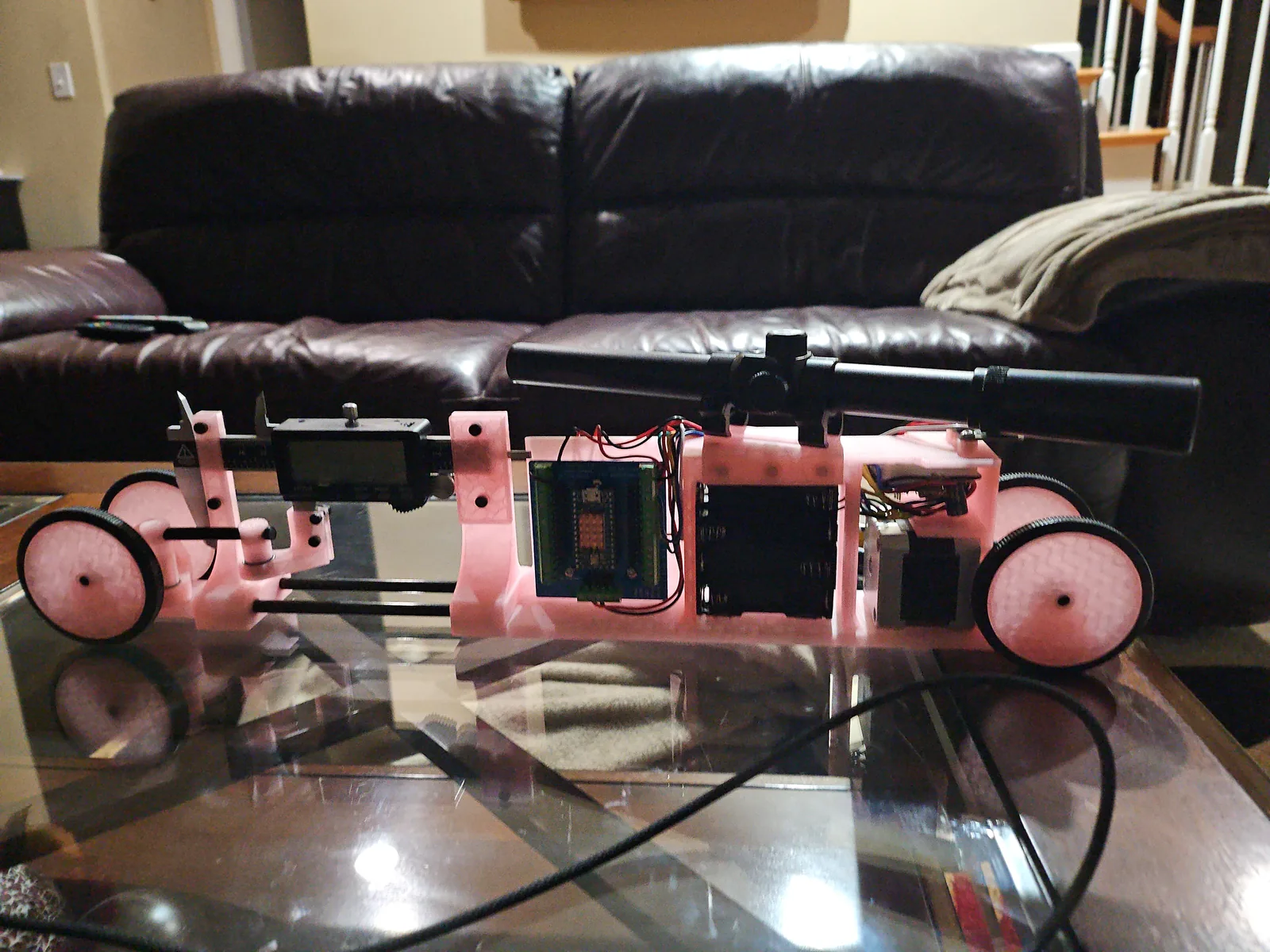
A narrow vehicle built to balance distance accuracy, a timing constraint, and clearance between scoring cans. I completed all CAD design and programming, with my partner helping with vehicle testing.
Engineering process
My role
I wrote all the vehicle code and completed all CAD design. My partner helped with testing.
Designing around new constraints
The 2025 vehicle emphasized speed. In 2026, a timing constraint and a turn between cans added requirements alongside target-distance accuracy. Passing between more closely spaced cans offered additional bonus points, so I prioritized a narrow vehicle layout. The vehicle used caliper steering to make the turn.
A new motor and controller
The vehicle moved from a brushless motor and ESC to a stepper motor, aiming for more repeatable motion and simpler control logic. A Teensy 4.0 replaced the Arduino Mega used in 2025, providing a smaller package and more processing headroom.
Programming the timed run
The firmware converts travel distance into wheel steps and calculates the peak step rate from the requested duration and acceleration. A button press starts the acceleration, travel, and deceleration sequence.
State competition
The vehicle placed third at States and passed close to the far can as intended. The team kept the existing can spacing for that run instead of narrowing it further for additional bonus points.
The unfinished spring redesign
I completed the CAD for a spring 2026 redesign, had the frame printed, and ordered some of the parts. School commitments and other Science Olympiad builds prevented me from completing assembly. Its CAD model is available alongside the vehicle used in competition, clearly labeled as unfinished.
Explore the build
Built for 2026
The assembled vehicle used in 2026. The separate spring redesign reached frame fabrication, but assembly remained unfinished.
Open photoState competition
3rd placeThe 2026 EV travels across the competition floor.
Open videoThe design used in 2026.
Timed stepper motion
Converts travel distance into wheel steps, then calculates a peak speed from the requested duration and acceleration. A button press starts the run.
- Travel setting
- 8 m
- Time target
- 10 s
- Library
- AccelStepper
Values shown are configured inputs, not measured performance.
#include <AccelStepper.h>

#define STEP_PIN 22
#define DIR_PIN 19
#define EN_PIN 23
#define BTN_PIN 18

AccelStepper st(AccelStepper::DRIVER, STEP_PIN, DIR_PIN);

// Distance you want the vehicle to travel
float dist_m = 8.0f;

// Wheel + motor setup
float wheel_d_mm = 63.91f;
int full_steps_per_rev = 200;
int microsteps = 16;

// Target time for the move
float T_target_s = 10.0f;

// Acceleration in steps/sec^2
float accel_stepsps2 = 8000.0f;

/*
Solves for the max speed needed to travel a certain number
of steps in exactly T seconds using a trapezoidal profile.

Motion equation used:
  T = D/v + v/a

Rearranged into:
  (1/a)v^2 - T*v + D = 0

Then quadratic formula is used to solve for v.
*/
static bool solve_vmax(long d_steps, float T, float a, float &vmax_out) {
  if (T <= 0.0f || a <= 0.0f) return false;

  // Make distance positive for the calculation
  double d = (double)((d_steps >= 0) ? d_steps : -d_steps);

  double A = 1.0 / (double)a;
  double B = -(double)T;
  double C = d;

  // Quadratic discriminant
  double disc = B * B - 4.0 * A * C;

  // If negative, the requested time is physically impossible
  // with the acceleration that was chosen.
  if (disc < 0.0) return false;

  double sqrt_disc = sqrt(disc);

  // Two possible quadratic solutions
  double v1 = (-B - sqrt_disc) / (2.0 * A);
  double v2 = (-B + sqrt_disc) / (2.0 * A);

  // Normally the smaller positive root is what we want
  double v = v1;

  if (v <= 0.0) v = v2;
  if (v <= 0.0) return false;

  vmax_out = (float)v;
  return true;
}

/*
Travels a specified distance in METERS.

The function:
1. Converts wheel diameter to meters
2. Calculates wheel circumference
3. Calculates microsteps per wheel revolution
4. Calculates steps per meter
5. Converts requested distance into steps
6. Calculates the required AccelStepper max speed
7. Runs the motor using AccelStepper
*/
void runMoveTimedMeters(float meters) {
  // Convert wheel diameter mm -> meters
  float wheel_d_m = wheel_d_mm / 1000.0f;

  // Wheel circumference
  float circ_m = 3.14159265358979323846f * wheel_d_m;

  // Total microsteps per wheel revolution
  float microsteps_per_rev = (float)(full_steps_per_rev * microsteps);

  // Calculate how many step pulses equal one meter
  float steps_per_meter = microsteps_per_rev / circ_m;

  // Convert requested travel distance into steps
  long steps = lroundf(meters * steps_per_meter);

  // This will contain the calculated peak speed
  float vmax = 0.0f;

  /*
  Calculate the exact max speed required so that:
    distance = steps
    acceleration = accel_stepsps2
    total time = T_target_s
  */
  bool ok = solve_vmax(steps, T_target_s, accel_stepsps2, vmax);

  /*
  If the requested time is impossible with the selected
  acceleration, use average speed as a fallback.
  */
  if (!ok) {
    float d = (float)((steps >= 0) ? steps : -steps);
    vmax = d / T_target_s;

    // Prevent extremely slow speeds
    if (vmax < 50.0f)
      vmax = 50.0f;
  }

  // Give AccelStepper the calculated profile
  st.setMaxSpeed(vmax);
  st.setAcceleration(accel_stepsps2);

  // Reset position so this move starts at 0
  st.setCurrentPosition(0);

  // Tell AccelStepper how many steps to move
  st.move(steps);

  // Continue calling run() until movement is complete
  while (st.distanceToGo() != 0) {
    st.run();
  }
}

void setup() {
  // Enable stepper driver
  pinMode(EN_PIN, OUTPUT);
  digitalWrite(EN_PIN, LOW);

  // Start button
  pinMode(BTN_PIN, INPUT_PULLUP);

  // Reset position
  st.setCurrentPosition(0);
}

void loop() {
  static int lastBtn = HIGH;
  int btn = digitalRead(BTN_PIN);

  /*
  Detect button press edge:
  HIGH -> LOW
  */
  if (lastBtn == HIGH && btn == LOW) {
    // Run the vehicle for the specified distance
    runMoveTimedMeters(dist_m);

    // Simple debounce
    delay(300);
  }

  lastBtn = btn;
}